

Published: April 20, 2026 • 8 min read
Every morning, millions of Indian men stand in front of their wardrobes, staring at a mountain of clothes, only to utter the exact same phrase: “I have nothing to wear.”
If you are a working professional navigating the fast-paced corporate environments of Mumbai, Bangalore, Delhi, or anywhere else in 2026, time is your most valuable asset. Spending fifteen minutes every morning figuring out if your patterned shirt matches your trousers is a massive drain on your energy. The solution? A capsule wardrobe.
In this comprehensive 2026 edition guide, we are going to break down exactly how you can build a men’s workwear capsule wardrobe from scratch. Tailored specifically for the Indian climate, modern office cultures, and the refined tastes of middle-aged professionals, this guide will help you look sharper, spend less, and eliminate decision fatigue.
In this Article
- 1. What is a Capsule Wardrobe?
- 2. Why Indian Professionals Need a Capsule Wardrobe
- 3. The Core Rules of Building Your Wardrobe
- 4. The 15-Piece Workwear Blueprint
- 5. 5 Days, 5 Outfits: How to Mix and Match
- 6. Step-by-Step Guide to Starting Today
- 7. Wardrobe Maintenance & Care in India
- 8. Frequently Asked Questions (FAQs)
1. What is a Capsule Wardrobe?

The term was coined in the 1970s, but the history of the capsule wardrobe proves that minimalism in fashion is timeless. A capsule wardrobe is a curated collection of versatile, high-quality clothing items that can be seamlessly mixed and matched to create a wide variety of outfits.
Instead of owning 40 items that only work in specific pairings, you own 15 to 20 items that all complement each other. The result is an exponentially higher number of outfit combinations with a fraction of the clothing.
💡 Looking to upgrade more than just your wardrobe? Read our related guide on the Top 10 Grooming Essentials Every Indian Man Needs in His Cabinet.
2. Why Indian Professionals Need a Capsule Wardrobe in 2026
As an Indian professional, building a wardrobe isn’t just about looking good; it’s about navigating unique local challenges.
- The Climate Paradox: You might endure 40°C heat and 90% humidity during your commute, only to sit in a freezing, air-conditioned office for nine hours. You need breathable fabrics that can be elegantly layered.
- The Hybrid Shift: Corporate dress codes in India have evolved drastically by 2026. The strict suit-and-tie era is mostly gone, replaced by “elevated smart-casual.” A capsule wardrobe perfectly bridges the gap between formal boardrooms and relaxed Friday stand-ups.
- Decision Fatigue: Men in their 30s, 40s, and 50s juggle intense careers, family duties, and personal health. Eliminating outfit choices saves immense mental bandwidth.
- Cost Per Wear (CPW): Buying cheap, trendy clothes leads to fading fabrics and torn seams after three washes in hard Indian water. Investing in fewer, high-quality pieces lowers your overall “Cost Per Wear.”
3. The Core Rules of Building Your Wardrobe
Before we buy anything, we must lay down the ground rules for the 2026 capsule wardrobe.
Rule 1: Fit is Absolute King
You can wear a ₹20,000 designer shirt, but if it doesn’t fit correctly, it will look cheap. Conversely, a ₹2,000 shirt tailored to your exact measurements will make you look like a million bucks. Indian men often buy clothes one size too large for comfort. In 2026, embrace tailoring. Find a reliable local masterji (tailor) and have your ready-to-wear shirts darted and your trousers hemmed to a modern, slight break.
Rule 2: Anchor with Neutral Colors
Your foundation must be built on neutral, versatile colors: Navy, Charcoal, Olive, White, and Light Blue. These colors flatter Indian skin tones incredibly well—from fair to deep brown—and they all effortlessly pair with one another.
Rule 3: Fabric is Function
In the Indian context, polyester is your enemy. Stick to natural fibers.
- Summer/Monsoon: 100% Cotton, Linen-Cotton blends (to prevent excessive wrinkling), and Poplin weaves.
- Winter (North India): Merino wool, heavy Oxford cloth, and Corduroy.
4. The 15-Piece Workwear Blueprint
Here is the exact formula for a fool-proof, robust men’s workwear capsule wardrobe in 2026.
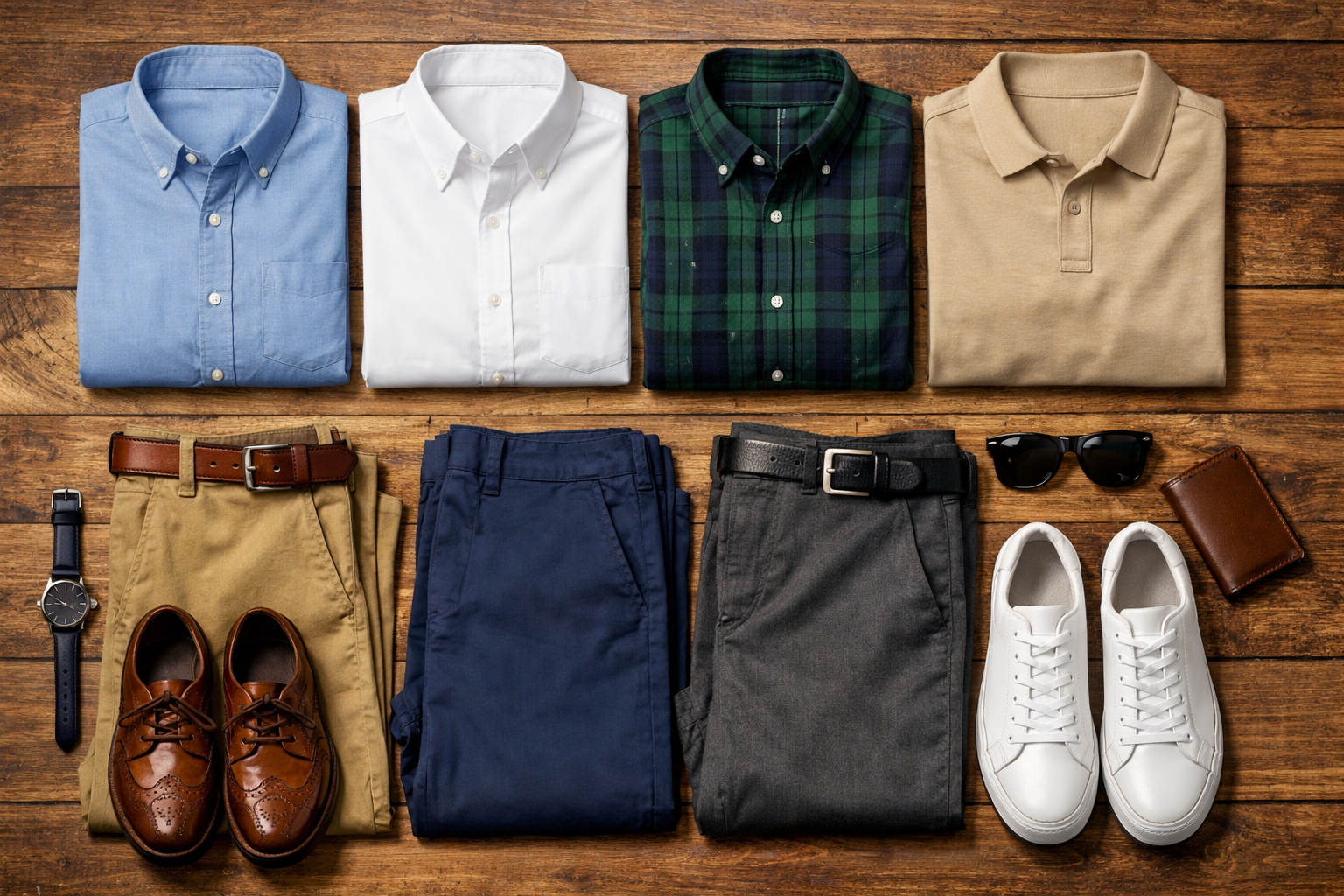
The Shirts (Quantity: 4)
Your shirts are the workhorses of your wardrobe. Ensure they fit well around the shoulders and don’t billow at the waist.
- The Crisp White Poplin: The ultimate essential. Perfect for big presentations, investor meetings, or layering under a blazer. Poplin is lightweight and breathable.
- The Light Blue Oxford Cloth Button-Down (OCBD): The OCBD is slightly thicker and more textured than poplin. The collar points button down, keeping it neat without a tie.
- The Navy Blue Linen-Cotton Blend: Darker colors look incredibly sharp on Indian men. A linen-cotton blend offers the breathability of linen without the extreme wrinkling.
- The Subtle Pattern (Micro-check or Bengal Stripe): Choose a conservative pattern in blue, grey, or subtle maroon to add visual interest to your wardrobe without clashing with your trousers.
The Trousers (Quantity: 4)
Trousers should sit comfortably at your natural waist. Ditch the skinny fits of the 2010s; 2026 is all about the classic, straight, or slim-straight silhouette.
- Navy Chinos: The most versatile pants you will ever own. They dress up with a white shirt and dress down with a polo.
- Khaki/Beige Chinos: A daytime classic. Pair these with your navy or light blue shirts for a quintessential smart-casual look.
- Charcoal Grey Dress Trousers: For days that require a touch more formality. Grey wool or high-quality poly-viscose blends drape beautifully.
- Olive Green Chinos: Olive acts as a fantastic “alternative neutral.” It breaks the monotony of blue and beige while remaining highly professional.
The Outerwear & Layering (Quantity: 2)
Even in cities like Chennai or Mumbai, air-conditioned offices require layers.
- The Unstructured Navy Blazer: Unlike a stiff suit jacket, an unstructured blazer has minimal padding. It breathes beautifully and instantly elevates a pair of chinos.
- The Grey V-Neck Sweater or Cardigan: Perfect for layering over your collared shirts during the milder winters in central India or the fierce AC chills of corporate towers.
The Footwear (Quantity: 3)
People notice your shoes first. Do not skimp on footwear. Invest in full-grain leather.
- Dark Brown Oxfords or Brogues: Brown leather is far more versatile than black for smart-casual wardrobes. It pairs exceptionally well with navy, khaki, and olive trousers.
- Black Penny Loafers: Slip-on convenience with a refined edge. Perfect for pairing with your charcoal trousers.
- Minimalist White Leather Sneakers: By 2026, white leather sneakers are fully accepted in Indian offices for casual Fridays. Ensure they are pristine, logo-free, and made of leather (not canvas).
The Accessories (Quantity: 2)
- The Reversible Leather Belt: A high-quality leather belt that is black on one side and brown on the other. Always match your belt to your shoes.
- A Classic Analogue Watch: A clean, unpretentious watch with a leather strap or stainless steel bracelet. It signals punctuality and attention to detail.
5. 5 Days, 5 Outfits: How to Mix and Match
To prove how effective this 15-piece wardrobe is, let’s look at a standard work week:
- Monday (The Executive): White Poplin Shirt + Charcoal Dress Trousers + Dark Brown Brogues + Navy Blazer.
- Tuesday (Smart & Sharp): Light Blue OCBD + Navy Chinos + Dark Brown Brogues.
- Wednesday (Mid-week Elegance): Subtle Patterned Shirt + Olive Chinos + Black Penny Loafers.
- Thursday (Creative Professional): Navy Linen-Blend Shirt + Khaki Chinos + Dark Brown Brogues.
- Friday (Casual & Confident): Light Blue OCBD (sleeves rolled up) + Navy Chinos + Minimalist White Sneakers.
6. Step-by-Step Guide to Starting Today

Ready to take the plunge? Don’t just throw everything out and rush to the mall. Follow these steps:
- The Wardrobe Audit: Take every single item out of your closet. Put them in three piles: Keep, Donate, and Tailor. If you haven’t worn a shirt in 6 months, it goes to the donate pile.
- Identify the Gaps: Compare your “Keep” pile with our 15-piece blueprint. Do you have 6 blue shirts but no white one? Do you lack a good pair of brown shoes? Write a precise shopping list.
- Invest in Quality, Not Logos: When shopping, ignore flashy logos. A plain, high-quality Egyptian cotton shirt from a homegrown Indian brand will always look better than a poorly fitting shirt plastered with a designer logo.
- Visit the Tailor: Take your newly purchased and “Keep” pile items to a tailor. Adjust sleeve lengths, taper trousers slightly, and ensure everything fits your current body type.
7. Wardrobe Maintenance & Care in India
Building a capsule wardrobe is an investment. In India, environmental factors can ruin clothes quickly if you aren’t careful.
- Combat Hard Water: Many Indian cities have high TDS (hard water), which fades colors and ruins fabric elasticity. Use a gentle, liquid detergent and avoid harsh powder bleaches. Wash darks inside out.
- Skip the High-Heat Ironing: The local dhobi (ironing service) often uses extremely hot, heavy coal irons that scorch fabrics and leave shiny marks on dark trousers. Invest in a home garment steamer. It removes wrinkles easily and extends the life of your clothes.
- Use Shoe Trees: The humidity in coastal cities like Mumbai or Chennai will ruin leather shoes. Always insert cedar shoe trees into your leather shoes after wearing them. They absorb moisture and maintain the shoe’s shape.
- Proper Hangers: Throw away the thin wire hangers you get from the dry cleaners; they ruin the shoulders of your shirts and blazers. Invest in thick wooden or velvet hangers.
8. Frequently Asked Questions (FAQs)
Conclusion
Transitioning to a capsule wardrobe is one of the most liberating lifestyle changes an Indian professional can make in 2026. By focusing on fit, neutral colors, and premium fabrics, you curate a closet that commands respect and exudes effortless style. Say goodbye to morning stress and hello to a wardrobe that works as hard as you do.
Transitional Capsule Wardrobe : 7 Powerful Secrets for the Perfect Fit
Transitional Capsule Wardrobe : 7 Powerful Secrets for the Perfect Fit
The Ultimate Guide to Building a Minimalist Capsule Wardrobe in 2026
3 Comments
This 2026 guide really resonates with the daily struggle of Indian professionals who want to look sharp without the chaos of decision fatigue. The emphasis on quality over quantity and the practical 15-piece blueprint make it easy to start building a workwear capsule that actually works for our climate and office culture. It’s refreshing to see a resource that’s both actionable and tailored to real-life needs.
[…] The Ultimate Guide to Building a Men’s Workwear Capsule Wardrobe From Scratch (2026 Edition)30 Effortless Outfit Combinations Indian Men Will Love in 2026Transitional Capsule Wardrobe : 7 Powerful Secrets for the Perfect FitThe Ultimate Guide to Building a Minimalist Capsule Wardrobe in 202630 Effortless Outfit Combinations Indian Men Will Love in 2026 busy managersCapsule WardrobeCloset Auditcloset resetwardrobe Maintenance By Sumit Bagadi […]
[…] The Ultimate Guide to Building a Men’s Workwear Capsule Wardrobe From Scratch (2026 Edition) […]