
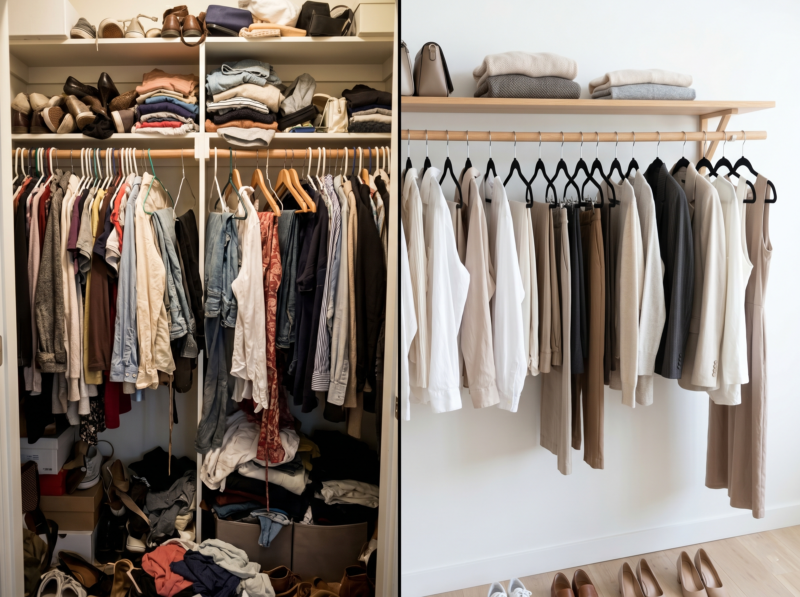
How to Declutter Your Closet When You Have “Nothing to Wear”

It is officially time to declutter your closet once and for all if you find yourself staring at a mountain of clothes every morning while muttering the infamous phrase, “I have absolutely nothing to wear.”
We have all been there: standing in front of hangers packed so tightly they practically screech when you try to slide them, drawers that refuse to close because they are overstuffed with tangled t-shirts, and shelves buckling under the weight of unworn sweaters. Yet, despite owning hundreds of individual garments, getting dressed feels like an impossible, exhausting chore. This paradox of choice is not a sign that you need to go shopping for more clothes; it is a blaring alarm that your current wardrobe is suffering from massive visual and functional congestion.
The sensation of having “nothing to wear” is rarely a true inventory problem. It is almost exclusively an organization and psychological problem. When your closet is filled with past mistakes, items that no longer fit, garments belonging to a lifestyle you don’t actually lead, and impulse purchases that still have the tags attached, your brain physically cannot process the viable options hidden within the chaos. You aren’t lacking clothes; you are lacking clarity. In 2026, as the professional landscape demands agile, confident, and effortless dressing, holding onto a chaotic wardrobe is actively sabotaging your morning routine and your self-esteem.
In this comprehensive, 2000+ word masterclass, we are going to walk you through a ruthless, highly effective closet cleanout system. We are not just going to tell you to throw away old t-shirts. We are going to deconstruct the psychological traps that make you hoard clothes, provide a step-by-step methodology to purge the excess, and teach you how to curate a breathable, functional space that makes getting dressed the best part of your day. Prepare to reclaim your closet, your style, and your sanity.
Table of Contents
- The Psychology of “Nothing to Wear” Before You Declutter
- Preparation: Essential Tools for Your Closet Cleanout Session
- The 5-Step Closet Declutter Process to Overcome Overwhelm
- How to Declutter Sentimental and Expensive Clothing
- Building Back: Transitioning to a Minimalist Wardrobe
- Level Up Your Wardrobe: Essential Guides
- Conclusion & Next Steps
The Psychology of “Nothing to Wear” Before You Declutter
Before you even touch a single hanger, we must address the root cause of wardrobe bloat. If you do not understand why you accumulate clothes you never wear, your pristine, newly organized closet will simply revert to a disastrous mess within six months. The phrase “nothing to wear” actually translates to “nothing to wear that makes me feel confident, comfortable, and aligned with who I am today.”
Understanding Decision Fatigue and the 80/20 Rule
Psychologists have long studied the concept of “decision fatigue”—the deteriorating quality of decisions made by an individual after a long session of decision making. When you wake up and are immediately forced to make 50 micro-decisions just to construct an outfit from a chaotic wardrobe, you deplete your cognitive reserves before you even leave the house. A cluttered closet is literally draining your energy.
Furthermore, the fashion industry universally acknowledges the Pareto Principle, or the 80/20 rule, as it applies to dressing. Statistically, most women wear exactly 20% of the clothing in their closet 80% of the time. The remaining 80% of your wardrobe is just expensive, space-consuming visual noise. Your goal is to identify and extract that golden 20%.
The “Fantasy Self” vs. Your Actual Lifestyle
One of the biggest hurdles to a successful closet cleanout is the “Fantasy Self.” Your Fantasy Self is the idealized version of you who attends glamorous cocktail parties every weekend, wears sky-high stilettos to brunch, or religiously goes to a 5:00 AM yoga class. You buy clothes for this Fantasy Self, but your Actual Self works a corporate hybrid job, loves comfortable smart-casual outfits, and spends weekends relaxing at home or running errands in sneakers.
To successfully purge clothes, you must brutally align your wardrobe with your Actual Lifestyle. If 70% of your life is spent in an office or working from home, 70% of your closet should reflect high-quality, comfortable professional wear. Acknowledging the gap between your fantasy and reality is the most liberating step in the decluttering journey.
Preparation: Essential Tools for Your Closet Cleanout Session
You cannot successfully overhaul your wardrobe in fifteen minutes before bed. A true closet cleanout requires dedicated time, physical energy, and the right logistical setup. Treat this like a strategic project. Block out an entire afternoon, put on an energetic playlist, and gather your supplies. Trying to declutter without preparation will only lead to a bigger mess on your bedroom floor.
- Heavy-Duty Trash Bags (Black): For items that are genuinely ruined, permanently stained, or beyond repair. Use opaque bags so you aren’t tempted to pull things back out once you have made a decision.
- Sturdy Cardboard Boxes or Bins: You will need designated zones for “Donate,” “Sell,” and “Alterations/Tailoring.”
- A Full-Length Mirror: You cannot guess how something fits. You must try on the items you are unsure about, and you need a well-lit, honest mirror to make the final call.
- A Temporary Rolling Garment Rack: This is a game-changer. It allows you to pull items out of the dark closet and view them in natural light, giving you a physical space to build your “Keep” section before putting it back.
The 5-Step Closet Declutter Process to Overcome Overwhelm
Now that you understand the psychology and have your tools ready, it is time to execute the physical purge. Do not skip or reorder these steps; they are designed to prevent the mid-cleanout panic that causes people to give up halfway through.

Step 1: The Total Pull-Out (Emptying the Space)
You cannot organize clothes while they are still hanging in the closet. You must completely empty the space. Take every single item—shirts, pants, dresses, shoes, belts, and scarves—and pile them onto your bed. Yes, the pile will look terrifying. That is the point. Seeing the sheer volume of what you own forces a reality check and provides the necessary shock value to motivate a ruthless purge.
Once the closet is entirely empty, vacuum the floor, wipe down the shelves, and clean the baseboards. You are preparing a pristine, fresh environment for your newly curated wardrobe.
Step 2: The Rapid Sorting Categories (Keep, Donate, Sell, Trash)
Pick up every item one by one and make a gut-reaction decision within 5 seconds. Do not try things on yet. Do not reminisce. Just sort them into four distinct piles:
The 4 Core Cleanout Categories
- The “Hell Yes” (Keep): Items you wear constantly, that fit perfectly, and make you feel incredible. Put these directly onto your rolling rack.
- The “No” (Donate/Sell/Trash): Items that are damaged (trash), items in good condition that you hate or haven’t worn in a year (donate), and high-end designer pieces that don’t fit but hold value (sell).
- The “Maybe” (Needs Review): This is for items you are torn about. Place them in a separate pile. We will deal with them in Step 3.
- The “Alterations” Pile: High-quality garments that you would love, *if* the hem was an inch shorter or a button was replaced. Put these in a bag to take to the tailor immediately.
Step 3: The Ruthless Fit and Condition Test
Now, turn your attention to the “Maybe” pile. This is where the real work happens. You must try on every single item in this pile in front of your full-length mirror. Be completely honest with yourself and ask these qualifying questions:
- Does this fit my body perfectly right now? (Not ten pounds from now, not two years ago. Today.)
- Is it comfortable, or will I be tugging at it all day?
- Is the fabric itchy, stiff, or unforgiving?
- Does this align with my current Actual Lifestyle, or my Fantasy Self?
- If I were shopping right now, would I buy this item at full price again?
If the answer to any of these questions is negative, the item must leave your house. Do not keep clothing that makes you feel bad about your body. Your closet should be a place of empowerment, not a museum of guilt.
Step 4: Building Your Core Wardrobe Foundation
Look at the items that made it to your “Keep” rack. You will likely notice a pattern. Perhaps you have a strong affinity for navy blue blazers, structured white tees, or pleated trousers. These core pieces are the foundation of your personal style. Ensure that these remaining items can actually be worn together.
If you have kept a beautiful statement skirt but threw away the only blouse that matched it, you must evaluate whether the skirt is worth keeping, or if you need to strategically purchase a high-quality neutral top to make it functional. The goal is cohesiveness.
Step 5: Organizing the Keepers for Visibility
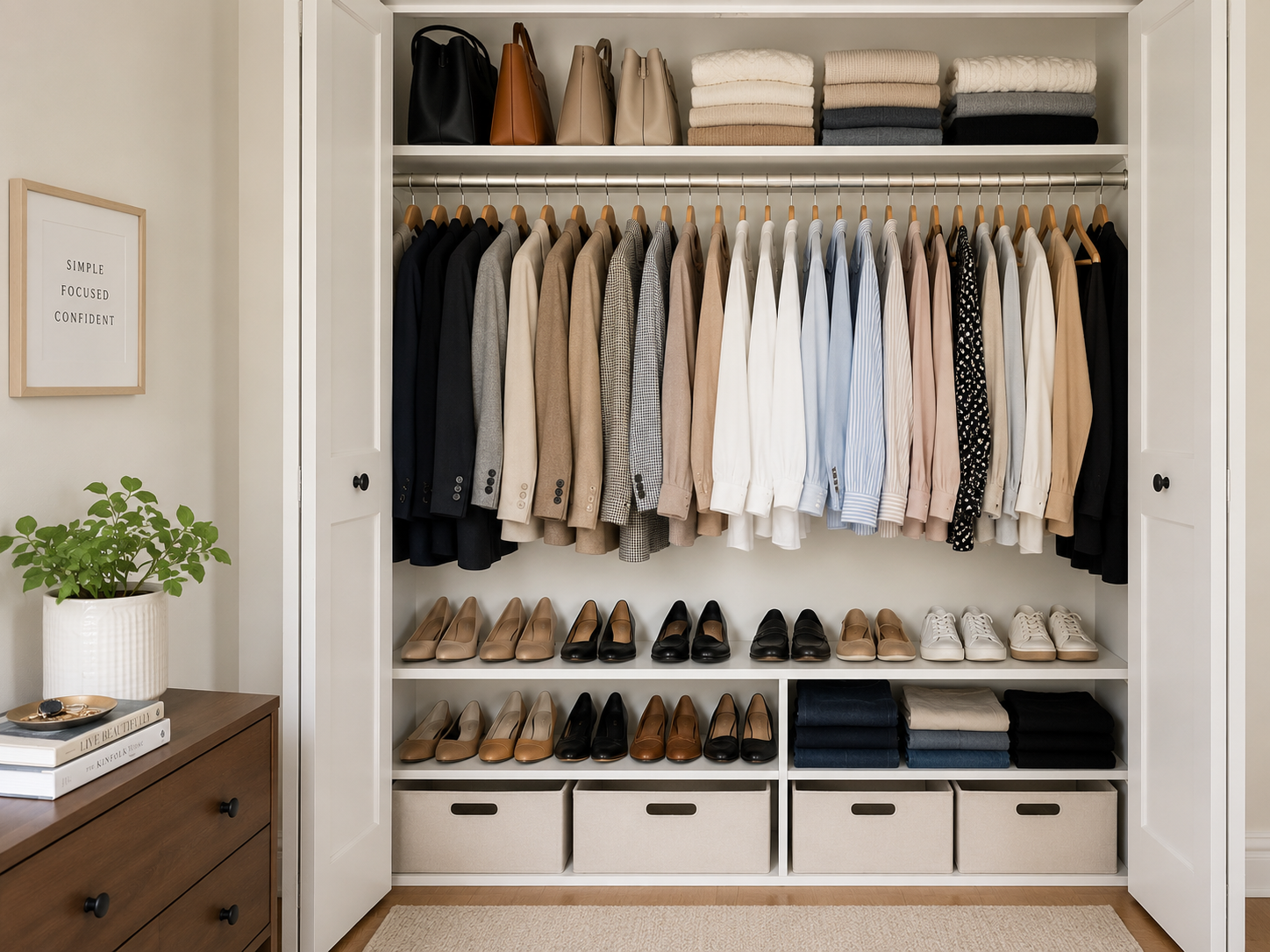
Now it is time to reload the closet. The cardinal rule of a functional wardrobe is visibility: if you cannot see it, you will not wear it. Here is how to architect your newly decluttered space:
- Upgrade Your Hangers: Throw away all mismatched plastic, wire, and bulky wooden hangers. Replace them completely with slim, velvet-flocked hangers. Not only do they prevent clothes from slipping, but they also give you back up to 30% more space on the rod and create an instantly luxurious, boutique-like aesthetic.
- Organize by Category, Then Color: Group all blazers together, all blouses together, all trousers together. Within those categories, arrange them by color (light to dark). This makes finding specific items effortless.
- The Two-Finger Rule: Ensure there is enough space between hangers to slide two fingers comfortably. Your clothes need room to breathe to prevent wrinkling and crushing.
How to Declutter Sentimental and Expensive Clothing
The hardest items to purge are never the cheap basics; they are the expensive mistakes and the sentimental attachments. Decluttering these items requires a distinct shift in perspective to overcome the “sunk cost fallacy.”

Dealing with Guilt Over Wasted Money
The “sunk cost fallacy” is the psychological trap that makes you keep an expensive silk dress you hate, simply because you paid $300 for it. You tell yourself that by keeping it, you aren’t wasting the money. This is fundamentally untrue. The money is already gone. Keeping the dress does not refund your bank account; it only costs you valuable mental real estate and closet space.
Forgive yourself for the bad purchase. The lesson has been learned. To soften the blow, utilize luxury resale platforms like Poshmark, The RealReal, or ThredUp to recoup some of the cost. Viewing the item as inventory to be liquidated rather than a personal failure makes parting with it much easier.
Preserving Memories Without Sacrificing Closet Space
What about your high school letterman jacket, the dress you wore on your first date with your spouse, or your grandmother’s vintage coat that doesn’t fit? These are artifacts, not active wardrobe pieces. You do not need to throw them away, but they absolutely cannot live in your primary closet taking up daily operational space.
Purchase high-quality, airtight archival storage boxes. Neatly fold these sentimental items with acid-free tissue paper and store them under your bed, in the attic, or on the absolute highest, hard-to-reach shelf in a guest room. You preserve the memory without compromising the functionality of your daily wardrobe.
Maintaining a Decluttered Closet: The One-In, One-Out Rule
Congratulations, you have successfully completed a massive closet cleanout. Your space is breathing, your clothes fit, and your morning routine is a joy. But how do you prevent the clutter from creeping back in? According to leading organization experts, including the principles championed by the National Association of Productivity & Organizing Professionals (NAPO), maintaining a space is heavily reliant on establishing friction against new acquisitions.
“A pristine closet is not achieved through a single weekend of cleaning; it is maintained through a lifetime of highly defensive shopping habits.”
Implementing Wardrobe Defense Mechanisms
- The “One-In, One-Out” Rule: This is non-negotiable. For every new item of clothing you bring into your home, an old item must leave. If you buy a new cashmere sweater, an old, pilled sweater must be donated. This creates an artificial capacity limit that forces you to evaluate whether a new purchase is genuinely better than what you already own.
- The 48-Hour Cart Rule: Impulse shopping is the enemy of a minimalist wardrobe. When shopping online, place items in your cart and close the tab. Wait 48 hours. If you are still obsessively thinking about the item, and can mentally construct three different outfits using items already in your closet, you may purchase it. 90% of the time, the urge will pass.
- Seasonal Mini-Audits: Do not wait for your closet to explode before cleaning it again. At the beginning of every season (Spring/Summer and Fall/Winter), perform a quick, 30-minute audit. Pull out anything that didn’t get worn in the previous season and immediately add it to a donation bin.
Level Up Your Wardrobe: Essential Guides
Now that your closet is an empty, highly functional canvas, it is time to build it back strategically. Do not rush out to buy fast fashion. Curate a wardrobe that demands respect, offers unparalleled comfort, and simplifies your life. Continue your sartorial education with these essential Outfit Anatomy masterclasses:
Conclusion & Next Steps
Learning how to meticulously declutter your closet is about far more than just interior design or tidiness; it is an act of reclaiming your personal time and defining your aesthetic identity. When you strip away the ill-fitting, the outdated, and the unwearable, what remains is a highly concentrated reflection of who you are at your very best.
Having a smaller, fiercely curated collection of high-quality clothing guarantees that you will never again stand in front of your wardrobe feeling lost or overwhelmed. Instead, you will experience the quiet confidence that comes from knowing every single piece on the rack fits you flawlessly, flatters your body, and serves a distinct purpose in your professional and personal life. Embrace the purge, trust the process, and step into a more refined, effortless version of your daily routine.
Build a Wardrobe That Works As Hard As You Do.
Ready to stop wasting money on clothes you never wear? Join the Outfit Anatomy newsletter to receive weekly, data-driven style formulas, exclusive capsule wardrobe blueprints, and actionable advice to build a smart-casual closet that completely eliminates decision fatigue.
Subscribe to the NewsletterAffiliate Disclosure: This article contains affiliate links. If you click through and make a purchase, Outfit Anatomy may earn a small commission at no additional cost to you. We only recommend products and storage solutions we genuinely believe provide exceptional value and quality to our readers.
Image Disclaimer: To provide the best possible visual representation of the organizational concepts, wardrobe layouts, and styling aesthetics discussed in this guide, some images featured in this article have been thoughtfully created or enhanced using advanced AI generation tools.